Last Updated on Aug 28, 2026
While snowfall itself isn’t an expense, clearing a property can be. The hours spent running machines, tending to them, and refueling all contribute to the overall cost of winter maintenance.
Purchasing equipment based on the lowest possible price can actually lead to higher expenses, especially when considering a commercial property. Instead, operators should look at which attachments are the most appropriate for the size and shape of their property, the consistency of the snowfall, the types of machines they can operate, and the storage or disposal options available to them.
Start With the Cost of Removing Snow
When removing snow, there is always a disposal location to contend with.
For large areas with ample room on the edges or along the roadside, pushing it into convenient piles can be the most time-efficient method, especially with the proper attachment. A commercial snow pusher is capable of transporting massive amounts of the material at once, without the operator having to backtrack and redistribute.
When the available space is more limited, moving it in this way can actually incur extra expenses. Piles take up room on a parking lot or in a field, restricting the movement of vehicles or the view for drivers. They also take up time that would otherwise be spent getting the area ready for use. In such cases, attachments that allow for moving or throwing to a greater distance or in a more specific direction can reduce the amount of time spent relocating.
Note that every additional cycle adds to the overall time spent removing snowfall.

Match the Attachment to the Work
A skid steer can be an extremely valuable asset when it comes to snow removal.
Not only can the machine be equipped with various attachments, but those tools can also be used on multiple projects. The real value is in finding the pieces that are the most appropriate and allowing the machine to do most of the work.
When clearing larger expanses of land, a snow pusher or plow can quickly make large piles along the edges. This may then allow for the use of a bucket to collect and move it to another location. While some people might think of a blower as an attachment that removes the need for transport entirely, it is best used on specific problem areas rather than bulk removal.
EMC Industrial currently carries an option for an 84-inch snow bucket, a 78-inch U-shaped snow pusher, an 84-inch hydraulic snow plow, and a 68-inch heavy-duty snow blower.
The value is in using the most appropriate tool for this job, reducing the total amount of work the operator has to do as well.
Calculate the Labor Costs Relative to Time
The cost of labor tends to be one of the largest expenses involved with commercial snow removal.
The faster an operator can remove the material, the fewer hours they have to spend doing so.
It is not always a matter of simply choosing the largest attachment available. While it may cover more ground, it can be less efficient when having to navigate around objects or when the snow has already accumulated in drifts and mounds. Instead, the key is to find the attachment that allows for the most productive time spent on the task.
Two machines might clear the same amount of snow, but one spends much of its time waiting or backing away to get out of the way. The other is able to move in relatively straight lines and get the material to where it needs to be without much ado. Regardless of the initial cost, the latter machine is a better investment over the course of an entire season due to its reduced hours of operation.
The layout of the property should also be taken into account before deciding on the width of the attachment.
Hydraulic Compatibility Can Affect Operating Costs
A snow attachment is not only about its ability to remove material.
The machine it is being attached to also has an impact on the process.
The flow and pressure of the hydraulic system impact how that attachment will perform. EMC notes that reviewing GPM requirements is an essential part of the process when pairing a skid steer with an attachment, especially when it comes to hydraulic options.
EMC’s 68-inch heavy-duty snow blower, for example, is recommended for a 12-24 GPM flow rate and 2,321-3,046 psi of pressure.
This attachment and the carrier should fall within the same range to prevent issues with performance and unexpected strain on either piece of equipment. Operators should review the compatibility before making a final purchase rather than risk wasting money on a tool that is inappropriate for that machine.
Reduce Repeated Snow Handling
One of the surest ways to increase the cost of snow removal is to require multiple attachments to handle the same material.
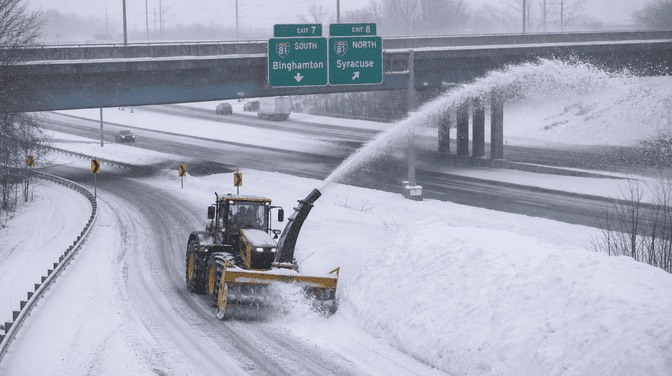
When removing snow, it is common to see a machine push it away, only to return with a bucket and move it again. This creates hours of wasted time and fuel spent on a single task.
Instead, operators should consider where the material needs to go before attempting to move it. If the onsite storage is sufficient, it might be best to simply push it to that location and leave it there. If that is not an option, then a blower might remove the need to spend so much time redistributing. If there are already large drifts, it could be more time-effective to switch to a bucket and move the material as much as possible.
The most appropriate attachment varies depending on how much storage space there is for the snow.
Equipment Versatility Has a Financial Value
Commercial operators should also take into consideration how often they need to use that particular attachment.
A skid steer with a range of tools can be used for other seasonal tasks besides snow removal, such as landscaping, construction, or material handling. This reduces the overall cost of the machine by spreading its use across more months of the year.
The same goes for the snow attachment itself. A property manager with a small amount of snow to deal with on a regular basis will not get as much use out of a specialized tool as a professional removing it from multiple commercial buildings. The former should consider the value of a lighter, simpler device while the latter might find it worth investing in a snow bucket or plow attachment.
The value is not just in the initial cost of a machine, but in how much it will be used over its lifespan.
Downtime Is an Often-Ignored Cost
Commercial properties do not always have the luxury of waiting for an issue to be resolved.
When dealing with snowfall, it is especially important to keep things running smoothly. A snowstorm that stops operation can affect everything from workers to customers, deliveries, and tenants.
This is why operators should also consider reliability when examining their options. Hours spent on the ground or in storage add to the overall cost of ownership. The true value is determined by a combination of productivity and downtime, both of which fall under the greater umbrella of equipment specifications and requirements.
EMC Industrial states that its own equipment comes with a 12-month warranty as per the published warranty terms , subject to the exclusions and conditions found within them.
This is not to say that snow removal equipment does not require any maintenance, but those hours spent running or repairing the machine add to the overall cost of ownership. Operators should consider this when comparing their options.
Choose Equipment Based on the Worst Useful Scenario
The ideal scenario for the least amount of snowfall possible is never going to happen.
Commercial operators should instead consider the amount of snowfall and how it would impact them before making a final decision.
Those with extensive pavement and reliable onsite storage might find that a snow pusher or plow is the most cost-effective attachment to use. Those with more limited space should consider a blower, and those with significant accumulations might want to invest in a bucket for removal. Finally, those with a smaller amount of surface area to clear could benefit from a separate machine altogether, rather than attempting to force a larger attachment into a restrictive environment.
The most valuable equipment configuration for an operator is the one that reduces the amount of time and effort spent on unnecessary movement, handling, and attachment switching.
Before purchasing, they should consider how much area needs to be cleared, how soon it needs to be done, where the snow can be stored, and what kinds of machines they have access to. Operators should then base their options on these variables, calculating the hours spent on the job rather than the initial cost of the equipment.
The end goal is to spend the least amount of productive machine hours on the task while still returning the property to a usable state. This can have a significant impact on the overall cost of removing such material over the course of an entire winter season.