Last Updated on Jul 29, 2026
Technology is transforming every industry. Whether it is defense, healthcare, finance, manufacturing, or cybersecurity, it is creating strong demand for IT professionals who can deploy, manage, and secure modern systems. According to the U.S. Bureau of Labor Statistics, employment in computer and IT occupations is projected to grow faster than the average for all occupations over the coming years.
With the rising need for individuals who are more than tech-savvy, employers are looking for people who are highly educated and able to take on roles in the sector, and looking for individuals who can demonstrate practical skills through labs, internships, projects, certifications, or portfolios—not just academic knowledge.
What this ultimately boils down to is that the program a person chooses is critical to their success. When they choose one where practical training integrates hands-on learning throughout the curriculum, they have more options for employment, as employers are looking at them as better prospective candidates.
This means that the information technology school they choose should focus on bridging the gap between classroom instruction and real-world experience, allowing the person to gain experience with industry tools and troubleshooting.
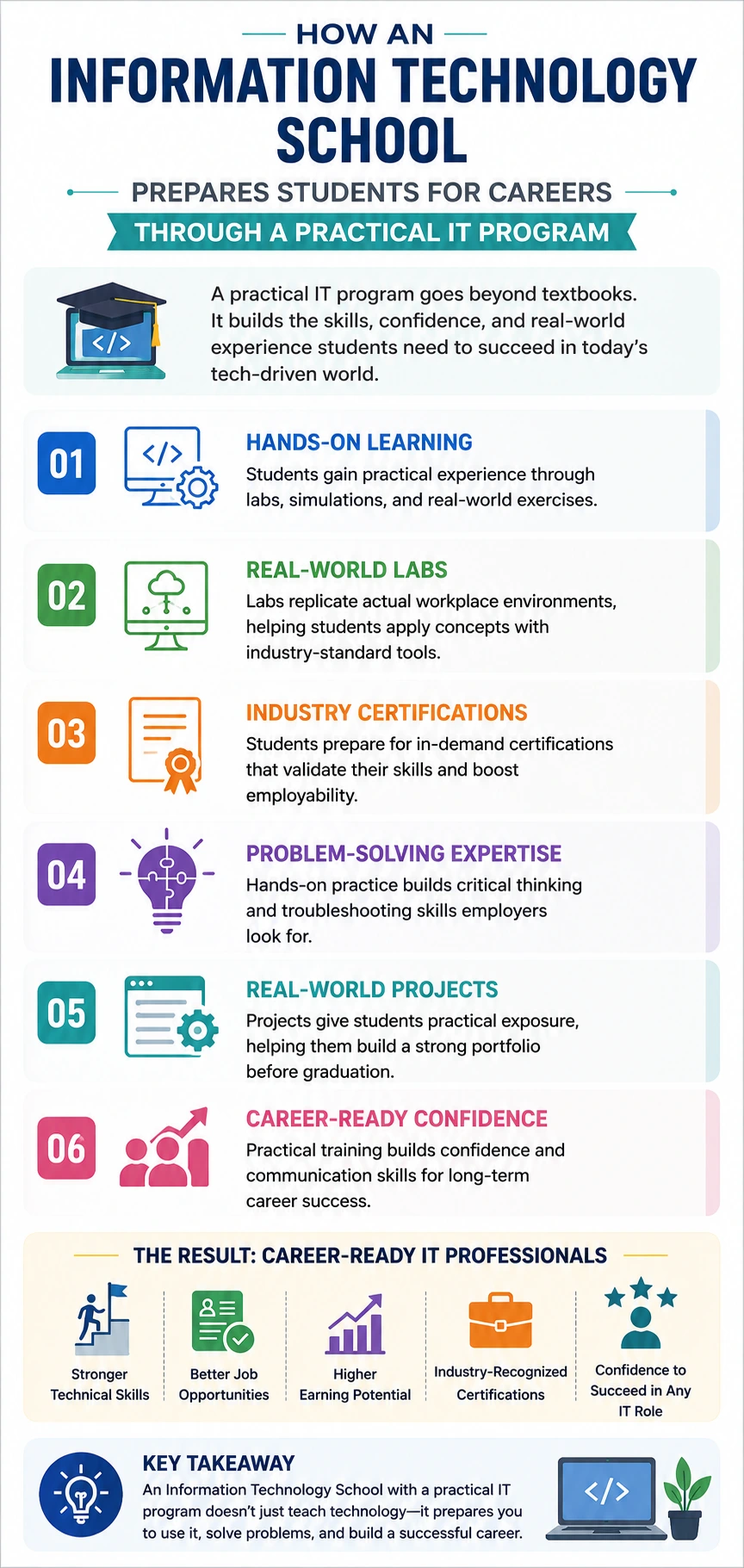
Why Practical Experience Matters in Information Technology
For the most part, information technology is a hands-on profession. You need an understanding of programming languages, different operating systems, networking concepts, and cybersecurity principles. A person’s understanding needs to go beyond general knowledge or textbook knowledge, though. They need to be able to apply the concepts to solve real-world problems like configuring a network, deploying a cloud service, or diagnosing a system failure, not just theoretical knowledge.
For example, a student may understand networking concepts from a textbook, but diagnosing a network outage or configuring routers and switches requires hands-on experience. Similarly, learning cybersecurity principles is different from identifying vulnerabilities, responding to threats, or securing live systems. Practical training bridges this gap by allowing students to apply classroom concepts in realistic environments.
Hands-on learning also develops critical thinking and troubleshooting skills. Through labs, simulations, and real-world projects, students learn how to analyze problems, test solutions, and make informed technical decisions. They gain confidence working with industry-standard tools and become better prepared to collaborate with colleagues, communicate technical concepts, and adapt to new technologies.
As a result, graduates with practical experience are often better prepared for internships and entry-level IT roles. Employers value candidates who can demonstrate technical competency through projects, labs, certifications, or portfolios because they are more likely to contribute effectively from day one.
Gaining Knowledge Through Real-World Labs
One of the most important benefits of a practical IT program is that a person will have access to hands-on labs. These simulate real workplace environments. Someone can also opt for tutoring when they don’t fully understand and want a more in-depth understanding. This can help them tie together practical knowledge and book learning.
Watching demonstrations and reading from books can only teach a student so much. When students participate in hands-on exercises, they connect classroom concepts with real-world scenarios, reinforcing what they have learned.
A student may learn to build and configure computers, install operating systems, set up virtual machines, and create computer networks. They learn to configure switches and routers, troubleshoot both software and hardware, practice cybersecurity techniques, and manage cloud computing programs.
Ultimately, students learn problem-solving firsthand and can make mistakes and learn from them. They strengthen their technical abilities in the process and strengthen their knowledge and troubleshooting skills before they find their first job.
Gaining Experience With Industry-Standard Technology
Technology changes quickly, and students entering the industry will need to stay up to date with it. For instance, the tech available in 2025 is already outdated in many cases.
Some current technology a student can expect to have in the classroom includes LLM Engineering, Linux operating systems, Windows Server, Microsoft Azure, Microsoft 365, and cloud infrastructure. These are the types of technology found in many workplaces nowadays.
Developing Strong Problem-Solving Skills
Above all the abilities a future IT professional can develop is problem-solving. While technology has advanced and improved, issues are always happening. Servers may fail. A network may go offline. Software may crash. And cybersecurity threats are always evolving.
In practical application, IT programs give students scenarios where they’re dealing with real challenges. They have to think them through and determine effective solutions to tackle them.
In this aspect of IT, merely memorizing answers for a test isn’t enough. They’ll better learn to diagnose technical issues, analyze problems and determine causes, understand how to test multiple solutions, and resolve issues effectively.
Honing your troubleshooting skills can be as valuable as developing technical knowledge.
Building Communication Skills
Part of your job in IT is communication, even though many people think it entails a person sitting behind a computer and having little human contact.
But you will actually need to collaborate with your teammates or with your clients during projects, meetings, or for reporting sessions. You will want to be able to speak to them in a professional and understandable manner. And if you have a client who needs further explanation, having a practical IT training background can better prepare you for that.
Preparing for Industry Certifications
A certification can demonstrate to future employers that you have taken an extra step to validate your skills. Practical training not only helps students prepare for certification exams but also reinforces the knowledge needed to apply those skills in real-world IT environments.
Some of the most widely recognized entry-level and professional IT certifications include:
- Cisco Certified Network Associate (CCNA)
- AWS Certified Cloud Practitioner
- CompTIA A+
- CompTIA Security+
- CompTIA Network+
Combining industry certifications with practical training demonstrates both technical knowledge and hands-on experience, making you a stronger candidate for IT roles.
Conclusion
If you have a passion for computers and technology, professional IT training can help turn that interest into a rewarding career. By participating in real-world projects, hands-on labs, and industry-focused training, you’ll develop the practical skills and confidence needed to succeed in today’s IT workforce.
Frequently Asked Questions
1. Why is hands-on experience important in information technology?
Hands-on experience allows students to apply theoretical knowledge in real-world scenarios. It helps develop problem-solving, troubleshooting, and critical-thinking skills while building confidence with industry-standard tools and technologies.
2. What skills can students gain through practical IT training?
Practical IT training helps students develop skills in computer hardware, networking, operating systems, cybersecurity, cloud computing, virtualization, troubleshooting, and technical communication. Many programs also introduce students to tools commonly used in professional IT environments.
3. Can practical IT training improve job opportunities?
Yes. Employers often value candidates who can demonstrate practical experience through labs, projects, internships, or certifications. Hands-on training can help graduates become job-ready and better prepared for entry-level IT roles.
4. Do employers value certifications or practical experience more?
Both are important. Certifications validate technical knowledge, while practical experience demonstrates the ability to apply that knowledge in real-world situations. Together, they create a stronger profile for IT employers.
5. What should I look for when choosing an IT training program?
Look for a program that combines classroom instruction with hands-on labs, real-world projects, experienced instructors, career support, and preparation for industry-recognized certifications. This combination provides a solid foundation for starting a career in information technology.