Last Updated on Apr 8, 2026
Open almost any electronic device—a smartphone, computer, home appliance, or industrial controller—and chances are the PCB inside is built on an FR4 substrate. In fact, FR4 accounts for more than 80% of the global PCB substrate market. From entry-level toy control boards to high-end telecom equipment and non-core automotive electronics, FR4 is everywPrinted circuit boardPrinted circuit boardPrinted circuit boardPrinted circuit board
That raises an obvious question. With so many PCB substrate options available—flexible PI, thermally conductive aluminum-backed boards, high-frequency PTFE, and high-temperature ceramic substrates—why has FR4 emerged as the default choice across the electronics industry?
The answer is surprisingly simple. FR4’s real advantage has never been that it leads the field in one extreme performance category. Its strength lies in balance. It offers the best overall combination of performance, cost, manufacturability, and versatility.
In this article, we will take a closer look at why FR4 has held its position as the leading PCB substrate for so long.
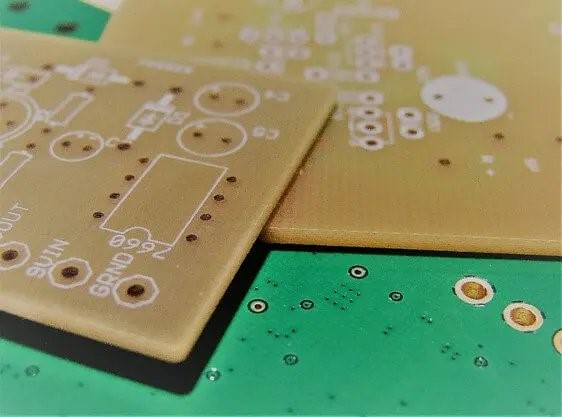
First, What Exactly Is FR4?
A lot of people assume FR4 refers to one specific material, but that is not quite accurate. FR4 is better understood as a material standard rather than a single, uniform product. The full name usually refers to a glass fiber-reinforced epoxy laminate, and the term is defined by a clear set of performance characteristics.
The “FR” stands for flame retardant, meaning the material meets the UL94 V-0 flammability standard. In practical terms, that means it will self-extinguish within 10 seconds after the flame source is removed, without dripping or continuing to burn. That is a fundamental safety requirement in electronics.
The “4” originally came from the U.S. NEMA classification system and refers specifically to a composite structure made from epoxy resin and woven glass fiber cloth. It was used to distinguish this material from older flame-retardant paper-based materials such as FR-1 and FR-2. Over time, FR4 became the common name for this entire class of PCB substrate.
Structurally, FR4 is a classic composite material. It uses woven fiberglass—typically E-glass—as the reinforcing framework, while flame-retardant epoxy resin acts as the bonding matrix. Under high temperature and pressure, the material is laminated and cured into a rigid sheet. Once copper foil is laminated onto the surface, it becomes the copper-clad laminate (CCL) used to manufacture PCBs.
Just as importantly, FR4 is not a one-size-fits-all material. It is a broad family of materials. Based on glass transition temperature (Tg), FR4 can generally be divided into:
- Standard Tg: 130–140°C
- Mid Tg: 140–160°C
- High Tg: 170°C and above
There are also specialized variants such as halogen-free FR4 and low-loss FR4, each tailored to different application needs. That built-in flexibility is one of the main reasons FR4 works across so many industries.
Reason #1: Balanced Performance With No Major Weaknesses
Electrical Performance: Stable and Good Enough for Most Designs
A PCB’s primary job is to carry signals and isolate circuits. FR4 performs very well in this role. Its volume resistivity is greater than 10¹⁴ Ω·cm, and its dielectric strength can reach around 20 kV/mm, giving it excellent insulation performance and helping prevent short circuits.
Its dielectric constant typically falls between 4.2 and 4.8 at 1 GHz, which is stable enough for most medium- and low-frequency signal transmission. For consumer electronics, industrial control systems, and standard communication equipment, that level of performance is more than sufficient.
It is true that in very high-frequency or ultra-high-speed applications—especially at GHz-level frequencies or data rates above 10 Gbps—FR4 cannot match specialized materials such as PTFE or Rogers laminates. But the reality is that over 90% of electronic devices do not require that level of performance. Smartphones, appliances, standard servers, and industrial equipment can all operate perfectly well on FR4, making it unnecessary to pay extra for performance that the product does not actually need.
Mechanical Strength: Tough Enough for Manufacturing and Daily Use
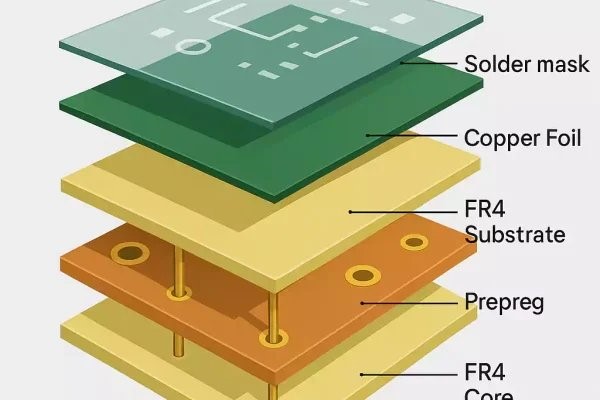
PCB manufacturing involves drilling, etching, lamination, soldering, and assembly. Once in use, the board also needs to withstand component weight, mechanical stress during assembly, and occasional minor impact. That is why mechanical strength is such an important requirement for both designers and any experienced FR4 PCB manufacturer.
The woven fiberglass inside FR4 acts much like steel reinforcement in concrete. It gives the board rigidity so it does not deform easily, while still providing enough toughness to resist brittle failure. A 1.6 mm FR4 board typically offers flexural strength around 200 MPa, making it durable enough for normal production and use conditions.
Compared with other materials, the difference is clear. Paper-based substrates like FR-1 absorb moisture more easily and are more prone to damage. Ceramic substrates are brittle and more likely to crack. PI substrates are excellent for flexibility, but they do not provide the same rigidity. FR4 strikes a useful balance between stiffness and toughness, which makes it highly practical.
Heat Resistance and Flame Retardancy: Built for Standard Electronics Safety
Electronic devices generate heat during operation, and PCB assembly processes such as wave soldering and reflow expose boards to temperatures around 260°C. That makes heat resistance and flame retardancy essential.
FR4’s glass transition temperature usually ranges from 130°C to 180°C, depending on the grade, allowing it to withstand standard soldering processes without softening, warping, or delaminating. Its UL94 V-0 flame-retardant rating also helps prevent fire from spreading in the event of an electrical fault.
Environmental Resistance: Reliable in Real-World Conditions
Many electronic products operate in humid or mildly corrosive environments, such as kitchen appliances or industrial workshops. FR4 offers good resistance to both moisture and chemicals. Even in environments with 90% relative humidity, its insulation performance remains highly stable, and it can resist attack from many common chemicals without requiring special treatment.
That reliability helps reduce maintenance needs and lowers the risk of field failures.
Reason #2: Exceptional Cost Performance
If balanced performance is FR4’s foundation, then cost efficiency is its most powerful competitive advantage. The electronics industry runs on scale, and scale depends on low, predictable costs. FR4 fits that model almost perfectly.
First, its raw materials—glass fiber and epoxy resin—are widely available and relatively inexpensive. Second, the production process is extremely mature. There are hundreds of PCB manufacturers around the world capable of producing FR4 copper-clad laminates, and the supply chain from raw materials to finished boards is highly developed. That means strong global production capacity, reliable availability, and much lower risk of shortages or price spikes.
FR4’s cost advantage becomes even clearer when compared with other materials:
- PTFE substrates can cost more than 10 times as much as FR4
- Ceramic substrates often cost 5 to 8 times more
- Aluminum-based PCBs are usually 2 to 3 times more expensive
- FR4 costs only modestly more than low-end paper-based materials, while delivering a significantly higher level of performance
For high-volume products like smartphones, appliances, toys, and consumer devices, even saving one dollar per PCB can translate into hundreds of thousands or even millions of dollars at production scale. That makes FR4’s value proposition extremely difficult to beat.
Reason #3: Excellent Manufacturing Compatibility
Easy to Process
FR4 is relatively easy to drill, machine, and etch. Hole accuracy can reach below 0.1 mm, which supports the production of higher-density boards. It also bonds well with copper foil, allowing clean circuit definition after etching without copper peeling issues. In many production environments, yield rates can remain above 95%, which helps reduce both process difficulty and rework costs.
Well-Suited for Multilayer Boards
As electronic devices become smaller and more complex, multilayer PCBs—4-layer, 8-layer, 16-layer, and beyond—have become increasingly common. FR4 has strong interlayer adhesion, which helps prevent delamination and void formation during lamination. That makes it suitable for everything from simple single-layer boards to complex high-layer-count designs.
This is a major advantage over paper-based materials and some flexible substrates, which are far more limited in multilayer applications.
Compatible With Standard Soldering Processes
FR4 works well with standard assembly methods such as wave soldering and reflow soldering. It does not easily deform or carbonize during soldering, and it is compatible with common solder pastes and solder mask systems. As a result, it can be integrated into existing SMT production lines without requiring major process changes or equipment upgrades.
That lowers manufacturing barriers for PCB shops and electronics manufacturers alike.
Reason #4: Highly Adaptable to Different Application Needs
FR4 is not only good as a standard-purpose material. It is also highly adaptable. By adjusting resin systems, glass styles, and process parameters, manufacturers can create a wide range of FR4 variants for different requirements.
For example:
- High-Tg FR4 is used in automotive electronics and industrial controls where higher thermal stability is needed
- Halogen-free FR4 is preferred in regions with stricter environmental regulations, such as parts of Europe, Japan, and South Korea
- Low-loss FR4 is used in faster signal transmission applications such as general-purpose servers
- Heavy-copper-compatible FR4 can be optimized for boards that require thicker copper layers
This combination of standard versions and customized variants allows FR4 to cover everything from consumer electronics and home appliances to automotive systems, communications hardware, and non-implantable medical equipment.
That kind of breadth is rare. Most other substrate materials are optimized for one narrow application area. FR4, by contrast, can stretch across a much broader range of use cases.
Comparing FR4 With Other PCB Materials
To better understand FR4’s advantage, it helps to compare it with other mainstream PCB substrate materials. Once you look at them side by side, it becomes clear why FR4 has become the default choice for most PCB applications.
| Material Type | Key Strengths | Main Limitations | Typical Applications | Compared with FR4 |
| FR4 | Balanced performance, cost-effective, easy to manufacture, customizable, flame-retardant, and heat-resistant | Not ideal for very high-frequency or ultra-high-heat applications | Consumer electronics, industrial control, communications equipment, non-core automotive electronics, and more than 90% of standard PCB applications | Best overall balance, no major weaknesses, and cost remains manageable |
| PI (Flexible) | Flexible and heat-resistant | Low rigidity, higher cost, and more complex processing | Foldable devices, wearable electronics, and flexible circuits | Excellent for flexible applications, but cannot replace FR4 in rigid board designs |
| Aluminum-Based PCB | Strong heat dissipation and good mechanical strength | Higher cost, less design flexibility, and not suitable for multilayer boards in most cases | LED lighting and high-power thermal management applications | Well suited for heat-intensive designs, but far less versatile than FR4 |
| Ceramic Substrate | Excellent high-temperature performance, strong high-frequency behavior, and outstanding insulation | Very expensive, brittle, and difficult to process | Extreme high-temperature, high-frequency, and high-reliability applications such as aerospace and advanced medical equipment | Delivers top-tier performance, but cost is too high for large-scale mainstream use |
| PTFE (High-Frequency) | Excellent high-frequency performance and low dielectric loss | Very expensive and difficult to process | 5G millimeter-wave, radar, and other advanced RF applications | Ideal for high-end RF use, but far less cost-effective than FR4 |
| Paper-Based Material (FR-1) | Very low cost | Poor heat resistance, moisture-sensitive, and weak mechanical strength | Low-end toys and simple remote controls | Cheap, but performance is too limited for mid-range and high-end electronics |
From this comparison, the conclusion is straightforward: other substrate materials either offer exceptional performance at a very high cost, provide low cost with limited performance, or only fit a narrow range of applications. FR4 stands out because of its balance and broad usability. It does not need to be the best in every category. It only needs to be the most practical choice for the majority of real-world designs, and that is exactly why it remains the industry standard.
Conclusion
FR4 has become the most widely used PCB material for a reason. It aligns almost perfectly with the electronics industry’s core priorities: scalability, affordability, reliability, and manufacturability.
It may not offer the highest high-frequency performance, the best thermal conductivity, or the flexibility of specialized materials. But for more than 90% of electronic products, those extreme capabilities are simply not necessary. What designers, OEMs, and every experienced FR4 PCB manufacturer need is a material that performs consistently, works well with standard fabrication processes, is widely available, and keeps production costs under control.
As the electronics industry continues to evolve, specialized materials such as PTFE and ceramic substrates will play a larger role in high-frequency and extreme-environment applications. Even so, FR4 is expected to remain the mainstream choice for standard PCB production.Learn